Monday, November 4, 2013

Introducing the Collections - The Tatiana Bechenova Collection


Tatiana Bechenova (c.1925-2012) was born in Sophia, Bulgaria, daughter of Paulina Belka of Odessa and George Bechenoff of Siberia.  She was raised in Paris and joined de Basil’s Original Ballet Russe at the age of fourteen.  Bechenova performed as a soloist from 1939 to 1947, traveling with the company around the world, including a tour in Australia and a longer sojourn throughout Central and South America.  After leaving Original Ballet Russe, she was a principal dancer for Agnes de Mille in the Broadway production of Carousel.  Following her marriage to Thomas O’Rourke, the couple moved to Dubuque, Iowa.  She taught ballet at Clarke College and opened the Academy of Ballet in 1958.  Bechenova founded the Dubuque City Youth Ballet in 1969 and, with her daughter Marina, established the Heartland Ballet in 1983. 
The Tatiana Bechenova Collection is the largest collection by number of items, although not by linear feet.  With over 900 photographs, her collection provides the most comprehensive picture of the dancers and the travel of the Original Ballet Russe during their sojourn in South and Central America.
Tatiana Bechenova in costume.  
Tatiana Bechenova joined the company shortly before the Original Ballet Russe's final trip to Australia.
Certificate from traveling on the S.S. Monterey from Australia
Train ticket traveling between Sydney and Brisbane in Queensland
Program from Brisbane performance on July 6, 1940.

Tatiana Bechenova on Bondi Beach in Sydney, Australia.
Christmas party on the S.S. Orcades on way to Australia in 1939

Her collection also includes the only materials we have related to the company's ill-fated trip to Cuba in 1941. Several of the dancers struck to keep their pay.  However, there was a major blowup between Colonel de Basil and his financier, Sal Hurok.  Due to this, the money to get the dancers  off the island was gone.  The dancers were trapped for several months before they were rescued with a new contract in South America.
Telegram to Tatiana Bechenova regarding the strike.

Roman Jasinsky, Moscelyne Larkin, and Tatiana Bechenova on the beach in Cuba.
Program from Havana in 1941.
Following a brief stint in the US and Canada, the company embarked on a five-year engagement across Central and South America.  The Bechenova collection contains hundreds of snapshots and performance programs from nearly every country in the region.  This collection contains the only large scale groupings detailing the movements of the Original Ballet Russe.

Tatiana Bechenova in front of Sugar Loaf in Brazil.


From the Teatro Colon in Buenos Aires, Argentina

Artist's Pass at the Palacio de Bellas Artes in Mexico City.
July 19, 1942 performance program from Montevideo, Uruguay

November 20, 1945 performance program from San Salvador, El Salvador

Performance program from July 5, 1945 in Caracas, Venezuela

November 10, 1945 performance program from Tegucigalpa, Honduras

They brought ballet in its most unique form to Central and South America as well as being a highlight in Australia.  The Bechenova collection is comprehensive in its materials regarding these somewhat lost years of the Original Ballet Russe.


Olga Morosova and Oleg Tupine in Le Coq d'Or

Graduation Ball, which was first presented in Sydney in 1940

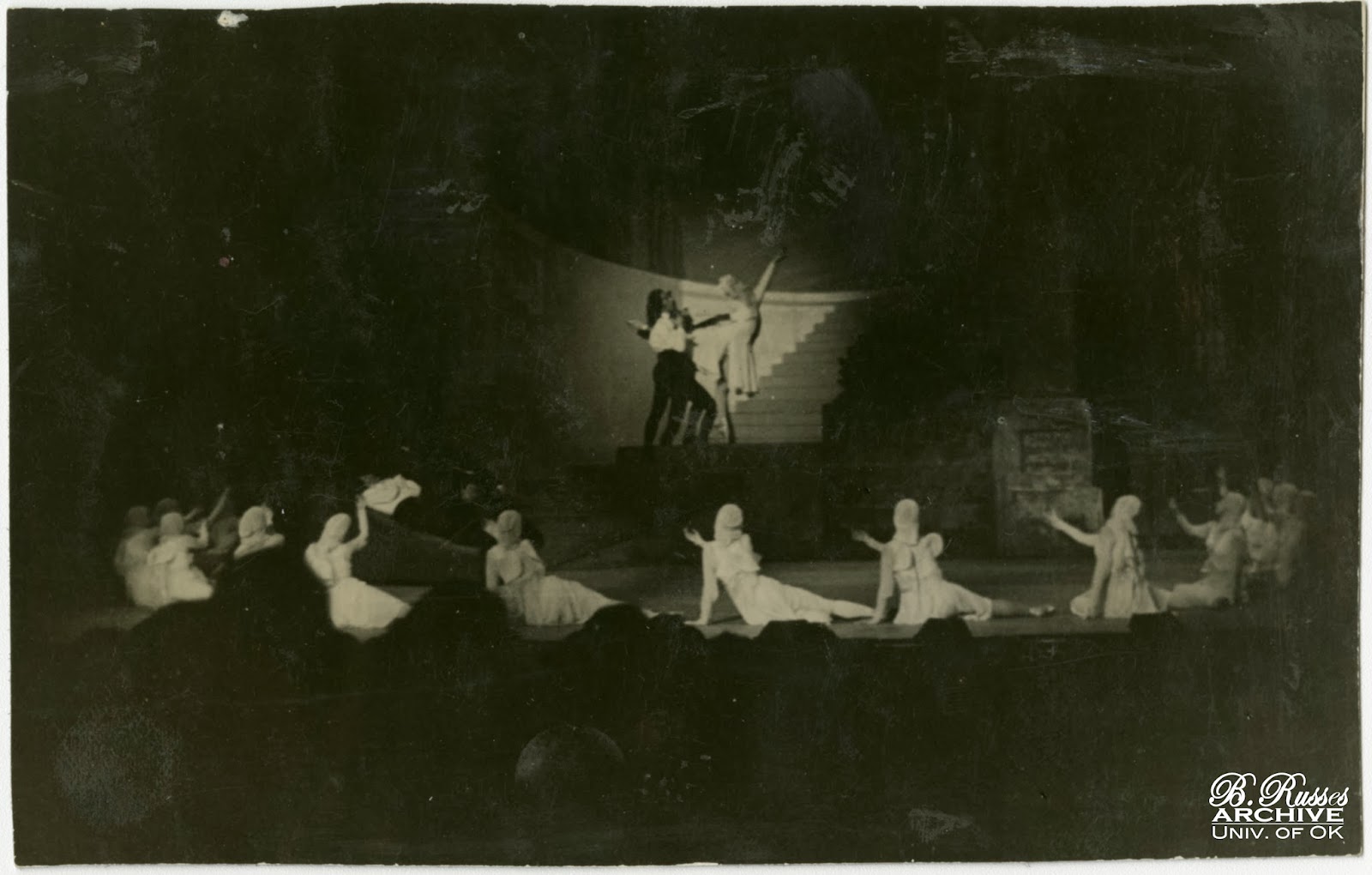
Peformance of Paganini


The Tatiana Bechenova Collection is the most recent major collection donated to the Ballets Russes Archive, and it may turn out to have the most research and historical merit in its coverage of Original Ballet Russe and the South American tour.

Monday, October 21, 2013

The Secret Side of Dancers - Drawing

Dancers had a lot of down time between traveling and performing.  Many of them turned to creative outlets to occupy themselves.  Various dancers took up different types of work including drawing.   One of the most prominent of these artists was George Verdak.


George Verdak.  Courtesy of the Bernice Rehner Collection
George Verdak was a member of the Ballet Russe de Monte Carlo from 1944-1951.  He spend much of the time outside of performances going to museums and movies with other dancers like Bernice Rehner and Shirley Haynes.  He had been a student at Chicago's Art Institute and took to drawing on nearly anything on which he could get his hands.


He would draw on the back sides of the pages of the stories of the ballets.

Courtesy of the Bernice Rehner Collection

He drew on doilies from the restaurants at which the company ate.


Hotels were always stocked with stationary, which led to drawings of costumes and other items.


Bernice Rehner would send home letters decorated by Verdak.

Perhaps his most famous contribution were his collection of "Fat Performers."  They appeared on Christmas cards, invitations, and placemats.


The drawings were so popular with the dancers that company members would fight for them.  

Courtesy of the Shirley Haynes Collection

 The drawings were also a part of the connection between Verdak and his friends.  Even after Bernice Rehner left the company, they kept in touch.  Much of their correspondence contains small drawings specific to her and their friendship.

While we often think of dancers as great artists in the area of dancing, it is exciting to see the other talents that were part of the Ballet Russe dancers.

Wednesday, October 16, 2013

Meet the Staff - Jeri Smalley


1.     Who are you and what is your position?
Jeri Smalley - Ballets Russes Archivist

2.     Please give us a little bit of background
I received my undergraduate and graduate degrees in dance from the University of Wisconsin – Madison and embarked on a career teaching dance, choreographing, and doing administrative work at colleges, companies, and studios in Wisconsin and Illinois. After a couple of moves and career changes, I received my MLS from the University of Oklahoma (OU) Library School in 2004 where I had taken archival courses with Kathleen Haynes of the faculty and Bill Welge of the Oklahoma History Center Research Division. I then volunteered at the History Center where I helped process a large collection donated by former Sac and Fox tribal official Mary McCormick.

3.     When did you come to the Ballets Russes Archive?
I saw the Ballets Russes film when the filmmakers Dayna Goldfine and Dan Geller presented it for a University of Oklahoma dream course. I had heard that the School of Dance had the archive and I spoke with the Director, Mary Margaret Holt, about volunteering to help organize and build the infrastructure of the archive.

4.     Why did you become a part of the Ballets Russes Archive?
I have a lifelong love of dance and was actively involved in the field for many years. Part of my study of dance history included reading about the Ballets Russes companies, their founders, dancers, and artists. Combining my dance and archival activities by working with the archive gives me the best of both worlds.

5.     What aspects of the Ballets Russes Archive have you worked on?
I came into the archive at a very early stage and have enjoyed helping shape it into a professional archive. I have helped create the infrastructure, drafting and refining the deed of gift that gives us legal right to the objects donors entrust to the archive, creating record tracking systems for donations, adopting systems for describing and arranging collections, seeking out and working with volunteers and organizations with whom we partner in order to make our holdings known and available to the public.

I have also enjoyed working with some of the graduate assistants from the School of Dance and the School of Library Studies at OU who have been involved with the archive in recent years and have worked diligently to further our goals of making our holdings available to as wide a public as possible.

6.     What are the biggest challenges you faced in working with the Archive?
As a very part time person, working with other part time personnel, there is always the knowledge that what “needs to be done” won’t happen at the speed at which you would like to see things happen. Also, as personnel graduate and are replaced, making sure that we record what we do for future personnel is ongoing and important.

7.     What are the biggest successes you have achieved with the Archive?
Helping shape the Archive (as I discussed earlier) from boxes of papers, photos, DVDs, and other items, into a useful, coherent group of archival collections. Taking a collection of not-very-organized and documented donations and helping shape them into processed collections with finding aids for many now available online. When I first volunteered with the Archive, a number of former dancers had donated manuscripts, photographs, ephemera, and digital files to the OU School of Dance. These items had been received and put into archival boxes by Peggy Chaffin, administrative assistant and donor liaison but had not been further processed.  Helping create the professional archival infrastructure and working with others to move the collections of objects into a cohesive, meaningful research resource has been very fulfilling.

8.     What are your favorite items or collections in the Archive?
One of the first collections I inspected and worked with was the Bernice Rehner Collection. This has remained one of my favorites because it is a time capsule in the life of a corps member of one of the Ballets Russes companies. It contains unique items that make the day-to-day lives of company members come vividly to life, including rehearsal schedules, snapshots, napkin art by company member George Verdak, correspondence pertaining to the American Guild of Musical Artists (Bernice was the AGMA representative for the company for a time), and correspondence with her family while she was in the company.
Although other collections including the Branitzka-Hoyer and Bechenova Collections are special for documenting transitional years from the Diaghilev era to the de Basil era, Bernice’s collection probably remains my favorite.

9.     What are your hopes for the future of the Archive?
I look forward to seeing the number of unique collections grow and become more accessible to researchers. With a web presence via our Facebook page, blog, and website we have begun to get some genealogically focused inquiries from people with family members and friends who had ties with one of the Ballets Russes companies and would like to know more about that time in their ancestor’s life.  I look forward to further use of the collection by students and researchers of dance, music, and the theatre arts both online and in house.

Thursday, October 3, 2013

Remembering Nichska - the Bernice Rehner Collection


 Bernice Rehner Barnes died on Sunday, September 29, at her home, surrounded by her husband Walt and her family.  We will miss her bright personality and unfettered joy at being a part of the Archive.  We are grateful to her for her amazing contribution and wish her family our condolences during this time.

The Bernice Rehner Collection is one of the largest and most diverse group of manuscripts and records that we have in the Ballets Russes Archive.  The collection contains a wide variety of documents that relate to her time as a student dancer at the School of American Ballet and her time in the Ballet Russe de Monte Carlo.  The collection includes some materials from her very early life as a dancer, including this adorable photograph.


Young Bernice Rehner


The Rehner collection contains the only materials in the Archive from the School of American Ballet in New York.  Bernice Rehner studied there with George Balanchine, among others, following her high school graduation in 1943.  She received her nickname, "Nichska," while there.  


In 1945, Bernice and 15 other students travelled with Balanchine and members of the Ballet Caravan to Mexico to perform with the Mexican Opera.  On July 19 and 25, they got a chance to give a concert featuring the students, Marie-Jeanne, and Nicholas Magallanes.  


Back in New York, she also got a chance to perform on TV in a version of Peter and the Wolf.  Bernice portrayed the Wolf and got to do a back flip.   It was also one of the first times she was paid for dancing.  
Bernice Rehner, Myrna Galle and other dancers in Peter and the Wolf Rehearsal

She was brought in to fill a corps spot in the Ballet Russe de Monte Carlo in February 1946 and stayed on contract with the company for the 10-week New York season.  Due to her close connection with her family, she was sending a number of telegrams home.


She also sent newsy letters, although by her own admission, she burned many of the letters her parents saved due to her "juvenile" language.

Bernice Rehner 
For the Hollywood Bowl season, the Ballet Russe de Monte Carlo needed a new more permanent corps member.  Due to her time with the company in New York, Freddie Franklin suggested Bernice because she knew all the dances already.  As part of the company, she was eligible to join the American Guild of Musical Artists (AGMA).  Her contract was for what would be considered hardly any money today, but she was overjoyed to be a real dancer with the Ballet Russe.


Bernice saved a number of unique items that allow us to understand what this time was like for a dancer in a touring company, including a number of rehearsal schedules.


Unlike many other dancers, we have very few pictures of Bernice from her time with the company.  Some of the pictures are from other collections, although this one is hers.

Bernice Rehner during her time with the Ballet Russe de Monte Carlo.
Photo courtesy of Maurice Seymour


She  saved a number of performance programs from the many places that the company performed.


She saved tour itineraries, hotel lists, and other travel items, detailing the time on the road by the company.


Bernice became great friends with fellow dancer, George Verdak, while in the company.  He was a very talented artist who made a habit of sketching fat performers on doilies, napkins, and place mats.  Due to their friendship, she ended up with a large collection of these drawings, which we are happy to have here.

"Fat Ballerina" by George Verdak.

Bernice remained with the company from 1946-1950 and was a part of some very exciting seasons.


The Hollywood Bowl season in the summer of 1950 was to be Bernice's last time performing with the company.  

Helen Seroy and Bernice Rehner at rehearsal in the Hollywood Bowl, July, 1950

Bernice met Walt Barnes in May 1950 just before the Hollywood Bowl season.  After her return, they were married less than two months later on September 24, 1950.  She left the company for a life in California with her beloved husband and never looked back.  They were married for 63 years.


When the Ballets Russes Archive was founded in 2007, Bernice Rehner was one of the first to contribute to the Archive.  She was always excited when we used her material.  We hope that she'd be pleased with this.  We are so grateful for the trust that our donors place in us to maintain their materials and preserve them for future users.  She loved dance and her time with the Ballet Russe de Monte Carlo remained a highlight of her life.


Thanks for the memories, Nichska.  We'll keep them safe for you always.

Friday, September 27, 2013

Materials in the Collection - Photographs

At the Ballets Russes Archive, we have a wide variety of materials that comprise our collections.  The most prevalent type of material that we have are photographs.  Nearly every collection contains photos, and some have photos as their primary type of item.

Being a dance archive, the typical photograph that people expect to see and that many donors give is the studio portrait.  These are often taken for a role, but they may also be used for a professional portfolio.
Paula Tennyson as Odette in Swan Lake.  Photo by Maurice Seymour

Many of these professional portraits are staged or only done in a photography studio.  However, professionals were also brought in to take shots during performances.
Performance of Swan Lake by the Original Ballet Russe.  

Many of the photographs that we find the most interesting are the backstage photos.  These provide a unique look into the experiences of the dancers from a view most patrons would never get to see. 

Tatiana Bechenova backstage with the Original Ballet Russe

Other truly entertaining photos come to us from general snapshots.  The dancers spent a lot of time together engaging in tourism, travel, and, occasionally, general silliness.   

Racing with eggs on board a ship.

Of course, our favorites come from our personal grouping of photos - "Dancers with Animals"

Nathalie Branitzka-Hoyer with a koala on Australian tour in 1936-7

Friday, September 20, 2013

Introducing Big Bertha

Like any heritage institution, the Ballets Russes Archive is constantly thinking about the storage needs of the collections.  No one has enough storage, and everyone is hoping to have newer and better facilities.  This Archive is no exception.

When the Archive began, there was no specific place designated for the collections.  The Archive moved into a space designated for storage and preparation used by the School of Dance.  Our space features a refrigerator, a sink, and lots of decorations for special events.  The cabinets that lined the walls held lights for performances, old posters and programs from the School, and serving items for gatherings and fundraisers.

To save money, the Archive shifted these items out of the file cabinets and moved in the archival boxes. The problem with this was archival boxes just fit exactly into the drawers and were difficult to move in and out.  Each of these boxes had to be removed carefully, yet over time, the edges would catch leaving the corners torn or the flaps looking ragged.  In addition, the higher boxes were harder to remove if they were heavy because they were higher than the normal range of motion used.


Old Storage System
Removal was often awkward and
there was a risk of damage to the material.


Luckily, the School of Dance is eligible for money from the Restricted Fund for Building Maintenance that was part of the grant bestowed on the University by the Donald W. Reynolds Foundation.  This fund allows the School to make changes to the physical assets of the Donald W. Reynolds Performing Art Center, which houses the Archive.  This year, the Fund allowed us to replace our old file cabinets with custom storage cabinets for our archival collections.  A former graduate assistant, Tara Davis, designed the layout of these cabinets and started sourcing vendors for us.  In the end, we got our cabinets from Delta Designs.  They were easy to work with and were able to make these large cabinets for us in a relatively short amount of time.

Big Bertha 1 and Big Bertha 2
To prepare for the move, we planned out where the various collections should go and made slightly bad drawings of drawer and shelf layouts.  Our Dance Fellow, Sierra Codalata, made a layout for where all of the materials would go before the move.  We had to take all of our collections out of the old cabinets and lay them out on tables in another room.

On moving day, the guys from Shipping and Receiving came in with our shiny new cabinets, they referred to them as Big Bertha.  We were so delighted by the term that that became the official name. We use it as the location within the Archive, referring to them as Big Bertha 1 (BB1) and Big Bertha 2 (BB2).
BB1 allows for storage of the few textiles we have (seen at bottom)
BB2 is where most of our books, scores, and scrapbooks are stored 

Retrieving materials from these cabinets is so much easier, even from the higher shelves.  The only issue we've had is that the drawers can't be pulled out too far or they fall.  We did have to do some hands-on construction as the shelves were a little too close together for the boxes, so we had to move them to fit.
Easier access to material!

Thanks to the Reynolds Fund for making this upgrade possible! Our only wish is that we had more of them in preparation for future collections.

Friday, September 13, 2013

Getting to Know the Collections - Nathalie Branitzka-Hoyer

Welcome to the Ballets Russes Archives series  - Getting to Know the Collections.  We wanted to share some of our most interesting collections with you.  Our first selection is the Nathalie Branitzka-Hoyer collection. 

Nathalie Branitzka was born July 18, 1905, in St. Petersburg, Russia. She studied ballet at the Petrograd Ballet School under the famous teacher Agrippina Vaganova in St. Petersburg. She later studied with Lubov Egorova in Paris. She started her professional career in the Anna Pavlova Company, continuing with Diaghilev’s Ballet Russe and appeared with Vera Trefilova and Pierre Vladimioff in Berlin. Following Diaghilev’s death, she performed with Boris Kniaseff's ballet company in Paris in 1930. She joined with De Basil's Ballet Russe de Monte Carlo dancing from 1932-1937. Rising to soloist, she made a world tour and appeared in many works by Leonid Massine, including Choreartium, Jeux d'Enfants, Beach and Scuola di Ballo, and in Mikhail Fokine's Carnaval and Les Sylphides. She moved to US to teach with her husband, Jan Hoyer, who had also been a member of both companies. She was the director of her own eponymous ballet school in New York City. She died March 8, 1977, in New York City.
Nathalie Branitzka-Hoyer

The Nathalie Branitzka-Hoyer collection is our one of our largest and most diverse collections.  It was donated by her son, Andre von Hoyer.  We have over 1,000 items, and it is the only collection large enough to warrant having series.  We have eight series in the collection.

The first and largest is manuscripts.  These materials include individual performance programs, season long souvenir programs, and notes.
De Basil’s Ballet Russe de Monte Carlo Performance Program from Royal Opera House Covent Garden, July 24, 1935

Series 2 is scrapbooks.  We have 7 scrapbooks from Nathalie Branitzka's time with the companies.  

Series 3 is photographic materials.  These include photos, negatives, and photographic postcards.  
Snapshot of Nathalie Branitzka and three dancers petting a koala on Australia tour, 1936-7

Series 4 is moving images.  We have five 8 mm reels of footage from the Ballet Russe and touring.

Series 5 is publications.  This series includes a number of different magazines.  
Issue of Dance and Dancers from October 1950; Volume 1, Number 10

Series 6 is books.  This is our largest collection of books and includes a number of Russian titles.

Our Ballet - Published in 1896

Series 7 is scores.  We have scores from many of the great ballets, including Firebird, Swan Lake, and the Nutcracker.

Sleeping Beauty

Series 8 is posters.  Because these posters are from the 1930's, they are not in very good shape.  Hopefully, we will be able to start conservation on them this year.


So, that's the Branitzka-Hoyer collection.  We're looking forward to sharing more of our materials with you over the next few months.